Iranian Revolution 2026: The Case for American Intervention to Aid Regime Change
There is a tendency in modern political analysis to lazily seek comparable situations, looking for what's obviously similar, while also failing to examine any of the uniquely distinguishing characteristics of one nation-state from another.
A Faulty & Lazy Comparison
There is a tendency in modern political analysis to lazily seek comparable situations, looking for what's obviously similar, while also failing to examine any of the uniquely distinguishing characteristics of one nation-state from another. The reality is that each is unlike the next, rife with its own struggles and challenges while simultaneously unburdened by the extenuating factors you might see in another isolated scenario.
Undoubtedly, regime change wielded as a tool by one nation (often with the co-operation of its cronies) over the destiny of another doesn't have a fantastic track record, especially when viewed through the lens of imperialism.
This is the crux of the online debate that rages around “regime change” as it pertains to Iran contrasted, not compared, to Iraq, Afghanistan or Syria.
So let’s start with some relevant background on those states that differentiate them entirely from Iran.
A Predisposition to Remaining Islamist
Practically speaking, this means that the populations of the aforementioned nations remain largely adherent to the very ideology that was weaponized with internal tribal warfare. You see this particularly in Iraq and Syria, where the representative tribe falls, only for another tribe to take power by force with the idea of continuing the Ummah (Muslim community or nation), but with their own power structures and vengeance.
This largely translates to a swap of like for like.
Fully Arabized Societies
Why does this happen? Because these societies have become fully Arabized.
Their true heritage was stamped out long ago by centuries of linguistic and cultural Arabization. Deprived of any living societal memory, their culture stands defeated and largely erased.
Curiously, this adheres to many modern arguments about "colonization," "hegemony" and "imperialism," and yet, these same critics are broadly silent as violent Islamic conquest continues today.
No Symbolically Significant Central Counter-figure
The entrenched tribal divisions in Iraq and Syria, combined with the absence of any organic resistance to the Taliban in Afghanistan, leave populations without hope or a unifying vision, and resign them to endure ongoing persecution.
It is important to understand the framework under which these countries operate, as it's important to understand that not all Middle Eastern countries are the same, and not all civil wars end in terrorism and chaos. For all his failings, for example, Al Sisi stabilized Egypt post-Morsi.
It is also critical to note that chaos in Iraq and Syria are largely driven by Sunni versus Shia state actors that take turns funding militant groups to war, at the expense of the people. The Islamic Republic was the leader in this campaign, only outflanked in Syria due to Israel’s intervention against IRI Quds forces.
Now, what does Iran have that the above countries are lacking?
A Different Paradigm
We could fill volumes with what stalled freedom for Iran, but among the most persistent external impediments is the idea that Iran is similar enough to its Arab neighbors to doom it to the same extremist chaos post-regime change. Iran's singular blend of ancient heritage, an exceptionally educated and Western-friendly youth, and a vast, globally connected diaspora, will not only shield it from the chaos of an extremist void, but dramatically propel a liberated nation toward becoming a new economic and cultural powerhouse, as well as a stabilizing presence in the region.
Connection to An Ancient Culture & Religion
Iranians are the proud children of Cyrus, and have resisted Arabization and being erased, even under occupation. They still speak ancient Persian (Farsi), and read the tales of their ancestral Shahs. They hold close their identity and culture. Many have organically returned to their native faith of Zoroastrianism, especially in recent years as discontent grows under the theocracy. Even against the oppressive regime’s efforts, mosques stand empty while old faith and holidays are renewed. You can see the national pride clearly in the lion and sun flag (shir o khorshid) - officially banned in Iran, but proudly flown in every protest. The lion and sun symbology dates back to the 12th century, with deep roots in Iranian traditions stemming from Zoroastrianism. After being replaced during the 1979 Islamic coup, the lion and sun flag has become a symbol of the opposition and the true Iran.
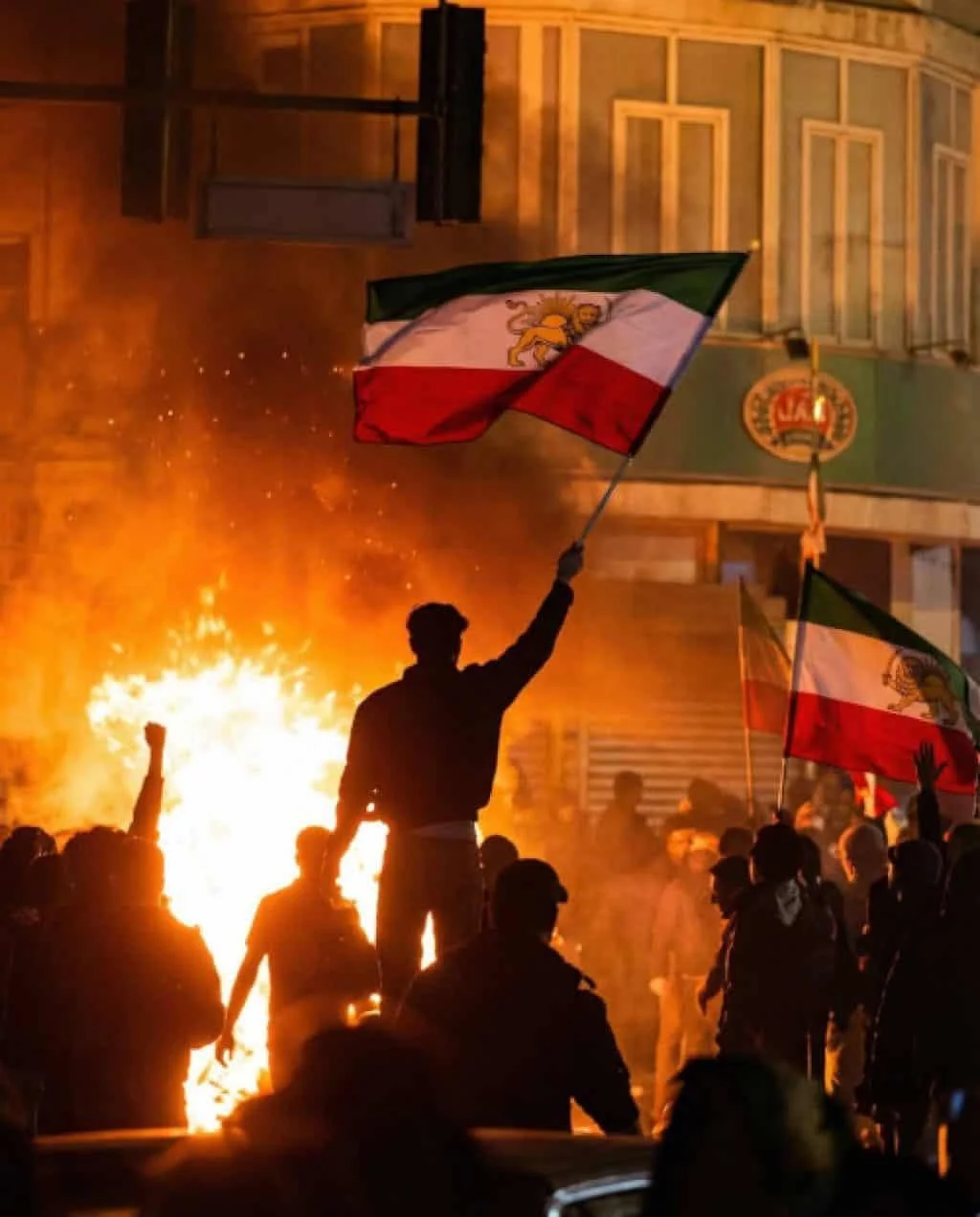
Revolutionaries in Iran flying the Iranian sun and lion flag during the uprising, January 2026.
National Pride
Unlike societies fractured by tribal divisions, Iranians are not slaves to such warfare. Though it's seen internal strife through the centuries, Iran's borders have endured for millennia, and its people have lived side by side longer than most Western countries have existed. Still, the arrogance of some outsiders suggests that a nation of such ancient continuity is somehow incapable of remaining intact.
To be clear, Iran does have other ethnicities and clans within its borders, and potentially, they can be vectors to be exploited by those who would want to destroy the integrity of the country. No action is without risk, but if the risks are known and understood, they can be managed.
The Return of the King
The return of the Shah (HRH Crown Prince Reza Pahlavi, son of the late Shah) to the public eye and his calls to action have brought millions of people to Iran's streets in open revolution. Iranians are rallying to Pahlavi, risking their lives and shedding blood for a shared vision. When he gives a directive, they respond in overwhelming numbers. This fact alone is a resounding referendum on their goal. They chant his name by the thousands and write it on walls, sometimes in their own blood. Their deafening message is imbued with centuries of monarchical tradition - unmistakable unless deliberately ignored.
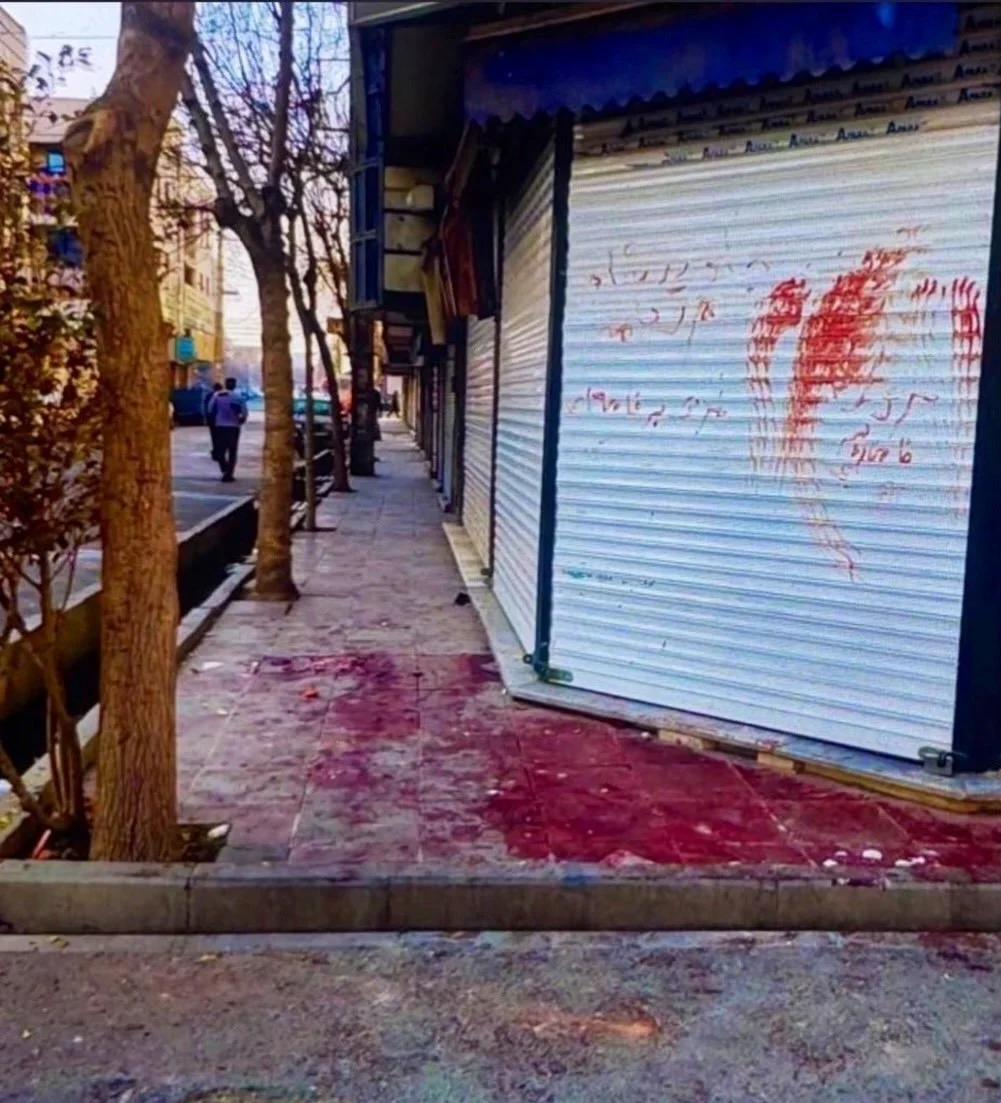
A photo of an outside wall in Tehran, with "Long Live the King" and "Death to Khamenei" written in Farsi in blood, January 2026.
A Plan of Action
More than just a symbol, Reza Pahlavi has emerged as a leader and presented a plan covering restoration of basic functions, establishment of diplomatic ties, rejoining the League of Nations, and so forth, including a national vote on the system of government and representation. This is not aimless chaos; there's a defined structure and methodology allowing Iran to move quickly and decisively post-Islamic Republic, complete with networks on the ground prepared to act.
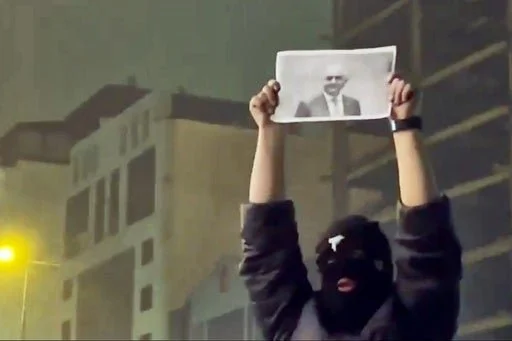
An Iranian protestor holding up a photo of Reza Pahlavi, January 2026.
The case for regime change is undeniable, and the myth of an immutable curse of regime change is based on false parallels to entirely different cultures. Allowing historical illiteracy to condemn 90 million people to suffer under violent oppression would be a travesty.
Which brings us to the case for American intervention.
America Lending a Hand Is Not America Invading
The idea of isolationism is, at its core, profoundly shortsighted. In an interconnected global economy and geopolitical landscape, it is neither practical nor sustainable. This is not an endorsement of unchecked globalism, but a simple acknowledgment of reality: manufacturing requires raw materials often sourced beyond one's borders, and profitability demands access to both domestic and international markets.
Securing favorable terms in trade, resources, and alliances requires the ability to project influence effectively. One cannot achieve this by retreating inward and remaining passive.
With that in mind, how would America stand to benefit from supporting the Iranian people's will: toppling the current regime and backing Crown Prince Reza Pahlavi as a transitional leader toward a free, secular Iran?
Strategic Mastery: A Free Iran Tilts the Balance Against China and Russia
A free Iran represents a massive victory in the balance of power against China and Russia. In the logic of great-power competition (major powers contesting influence, resources, and strategic access short of direct war), energy and infrastructure are leverage, not side issues. (U.S. Department of War) For years, Beijing has treated sanctioned producers as pressure valves: it has taken large volumes of Iranian crude oil at meaningful discounts, and it has relied on oil-backed lending arrangements elsewhere that convert barrels into geopolitical staying power. (Reuters) The strategic point is simple: if these discounted energy flows are disrupted, and if the associated commercial footholds (ports, logistics corridors, and resource concessions) become less secure, it raises the cost of power projection and weakens the supposed durability of China’s external network. When authoritarian client states face regime stress or financial rupture, and their patrons cannot, or choose not to, absorb the cost, it sends a signal to other would-be proxies that external protection has limits, reshaping alignments in ways that compound over time. (Reuters)
Immediate Relief for Consumers and Markets
If energy from a free Iran can re-enter global markets openly and at scale, without sanctions frictions that complicate buying, insuring, shipping, and financing, markets would likely price that in quickly. Oil is globally priced, so incremental supply and better certainty around Iran can lower the geopolitical “risk premium” that often inflates benchmarks like Brent, which then flows into diesel, jet fuel, and gasoline over the following weeks.
The key nuance is what “immediate” means: prices can react fast, but physical relief depends on how many additional barrels actually arrive and whether other producers (notably OPEC+) offset the increase by cutting elsewhere. Venezuela's recent dip is a reminder of the fluctuations that can occur after regime change.
A Near East Security Alliance That Reduces U.S. Troop Burden
US alliances with Iran, Israel, the UAE, and India would reduce US military engagement in the Middle East, while increasing revenue generated through military equipment and platform contracts with a near-east, NATO-like alignment. This is safer for US troops, less expensive for taxpayers, and boosts the economy through a new revenue stream.
Cutting Off the Head of the Snake
Perhaps the most consequential outcome of ending the Islamic Republic would be evaporating the regime’s ability to sponsor violence beyond its borders. For decades, Tehran has used state resources, front organizations, and proxy networks (Hamas in Gaza, Hezbollah in Lebanon, the list goes on) to finance, train, and coordinate extremist activity - targeting dissidents, destabilizing neighboring countries, and openly threatening Western interests.
Eliminating the Islamic Republic, the state sponsor and operational hub of much of the world’s terrorism, would in turn eliminate a large majority of the terror threat almost overnight. As their financial pipelines and logistical channels are dismantled, the capacity for organized attacks and intimidation campaigns falls dramatically, saving lives and reducing the long-term security burden for countries forced to defend against them.
Helping Iranians Win Their Future
A free Iran is not a theory; it’s the stated will of millions of Iranians who have risked everything to reclaim their country. The mistake many analysts make is assuming Iran must replay the same post-regime chaos seen elsewhere, despite Iran’s distinct national identity, social cohesion, and the presence of a credible unifying counter-figure with an articulated transition plan.
For the United States, supporting this outcome is not charity and it is not conquest. It is a strategic decision with clear upside: weakening adversarial blocs, reducing the need for sustained U.S. military posture in the region, expanding opportunities for security cooperation, stabilizing energy markets, and degrading the regime’s long-running proxy infrastructure.
The choice, then, is not between “doing nothing” and “invading.” It is between passively absorbing the costs of the current regime, or actively helping the Iranian people close this chapter on their own terms. If America wants fewer crises, fewer deployments, and a more stable Middle East, it should treat a free, secular Iran as a core national interest - and act accordingly.
==========
Moshe ben Yehudah (pen name) is a geopolitical and military analyst, focusing on the Near East, North Africa, as well as Central and South America. He is a veteran of the IDF, including combat service in urban, modern warfare.