Understanding the Islamic Republic's Security Forces
A Comprehensive Overview of Artesh, IRGC, Basij, NAJA, and MOIS
In discussions surrounding Iran's ongoing anti-Islamic Republic revolution, various military, paramilitary, and security forces operating under the regime's command are frequently mentioned. The Islamic Revolutionary Guard Corps (IRGC) certainly gets the most attention, because its primary responsibility is protecting the regime's ideological agenda, and it stands out as the most powerful and brutal force against the opposition. But there are multiple forces, often working in tandem, that are worth mentioning as we examine what’s happening in Iran.
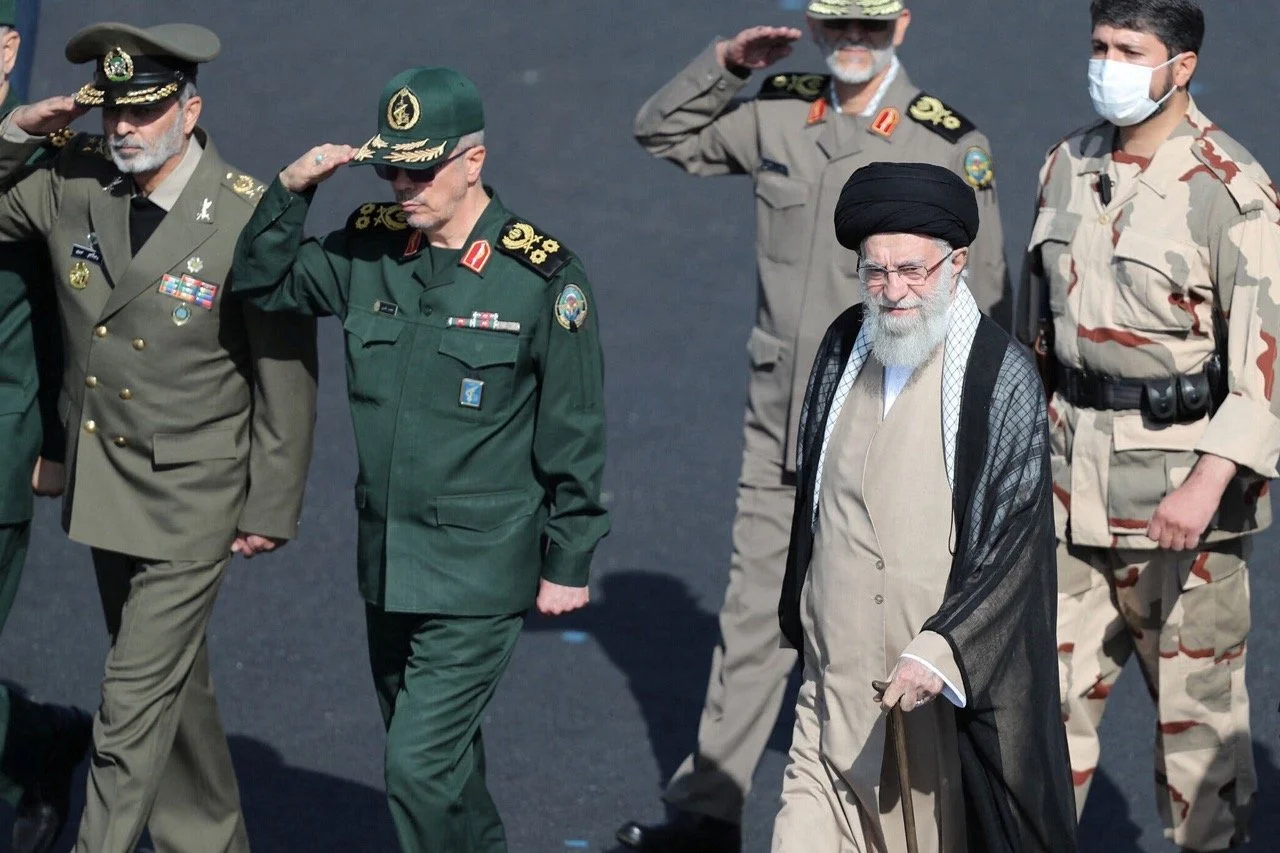
Iran’s “supreme leader”, reviewing the IRI’s armed forces.Credit.
© Reuters
Islamic Republic Militia Structure
The Islamic Republic operates a dual-structure armed forces system, comprised of the conventional military (Artesh) and the ideologically-oriented IRGC, alongside paramilitary militias and security and intelligence agencies. This structure was established after the 1979 Islamic Revolution largely to protect the regime from internal and external threats, with overlapping roles in defense, internal security, and ideological enforcement.
Below is a comprehensive list of key military, paramilitary, and security force groups, including short histories and purposes. Note that some entities are branches or subsidiaries of larger organizations, and the regime also employs proxy forces abroad (via the IRGC), but since we’re looking at these in the context of the current revolution and suppression, we’ll focus on core domestic groups.
1. Islamic Republic of Iran Army (Artesh)
Short history: Founded in the mid-1920s under Reza Shah Pahlavi as Iran's modern conventional army, it was restructured after the 1979 Islamic coup, purged of royalist officers, and integrated into the new Islamic framework. Despite this integration, there is still skepticism among some in the regime of the army’s loyalty to the Islamic Republic ideals. This is also one reason the exiled Crown Prince, Reza Pahlavi, recently called on members of the Artesh to defect and join the opposition - they are seen as significantly more likely to side with the Iranian people than the IRGC.
To counter potential anti-regime sentiment among the military, the Supreme Leader appoints ideological allies as representatives within their ranks, including the commander-in-chief. The Artesh played a major role in the Iran-Iraq War (1980–1988) and has since focused on professionalization despite competition from parallel forces.
Purpose: The Artesh serves as the primary conventional military for national defense against external aggression, including ground, naval, and air operations. It protects Iran's territorial integrity, borders, and sovereignty, with branches like the Ground Force, Navy, and Air Force emphasizing deterrence and warfighting.
2. Islamic Revolutionary Guard Corps (IRGC, also known as Sepah or Pasdaran)
Short history: Established in May 1979 by Ayatollah Ruhollah Khomeini shortly after the Islamic Revolution to counter potential coups from the Artesh and protect the new Islamic regime. It expanded quickly during the Iran-Iraq War, evolving from a small paramilitary group into a multifaceted force with economic, political, and military influence. The US designated the IRGC as a terrorist organization in 2019, and several other countries followed suit, including Canada, Australia, Bahrain, Saudi Arabia, Israel, Sweden, Paraguay, and Ecuador. The European Union also added the IRGC to its terror list in February 2026 following pres-sure from the international community and the Iranian diaspora after the crackdown on January 8-9 2026. The IRGC now numbers around 190,000–250,000 personnel.
Purpose: The IRGC is the “ideological guardian” of the revolution, with functions in internal security, asymmetric warfare, missile and drone programs, and exporting the revolution abroad. It maintains parallel branches to the Artesh (ground forces, navy, aerospace) and oversees elite units like the Quds Force for foreign operations and the Intelligence Organization for domestic surveillance and counterintelligence. Being the designated guardian of the Islamic ideals of the 1979 coup means the IRGC is generally more religiously fanatical, fundamentalist, and ruthless in its domestic suppression methods.
3. Basij Resistance Force (Basij-e Mostaz'afin, or Mobilization of the Oppressed)
Short history: Khomneini created this volunteer militia in November 1979 to mobilize the population to defend the revolution. The Basij was formalized in 1980, merged into the IRGC in 1981, and grew massively during the Iran-Iraq War. The Islamic Republic claims there are 20 million Basijis today, though active numbers are debated and range from 90,000 to 600,000 combat-capable members. It has been heavily involved in suppressing protests, including the 2009 Green Movement, 2019 uprising, and the current revolution. In protest and conflict footage out of Iran, you can often see Iranians pointing out Basijis wearing plain clothes to blend in with the protesters.
Purpose: The Basij is a paramilitary volunteer force for ideological indoctrination, social policing (enforcing Islamic regulations), riot control, and mass mobilization during crises or wars. It recruits from a number of demographics (youth, students, workers) and serves as a reserve for the IRGC, with roles in civil defense, propaganda, and monitoring dissent.
4. Law Enforcement Force (LEF; NAJA, or Faraja)
Short history: This group was formed in 1991 by merging the pre-revolutionary National Police, Rural Gendarmerie, and revolutionary committees into a unified force under the Interior Ministry (later directly under the Supreme Leader). The LEF evolved from post-revolution internal security needs, and is one of the Islamic Republic’s main security apparatuses for maintaining domestic stability. It played a major role in violently suppressing protests in the aftermath of the disputed June 2009 election, leading the United States to impose sanctions on the group in 2011 and 2012.
Purpose: Responsible for maintaining public order, law enforcement, border security (in coordination with IRGC), and countering smuggling, narcotics, and riots. It includes specialized units like anti-riot police and morality enforcement patrols, focusing on domestic stability.
5. Ministry of Intelligence and Security (MOIS, or VEVAK)
Short history: The MOIS was established in 1984 as the successor to the Shah's SAVAK (Organization of National Security and Information) intelligence agency, following purges and the need for a loyal apparatus to counter threats to the revolution. It has been linked to assassinations abroad and domestic crackdowns, and has overlapping roles with IRGC intelligence.
Purpose: The MOIS is responsible for intelligence gathering, counterespionage, and internal security operations to protect the regime from subversion, espionage, and opposition groups. It monitors dissidents, media, and foreign influences, often collaborating with the IRGC and Basij.
Additional Branches and Affiliated Groups
IRGC Quds Force: A special forces branch of the IRGC, created in the 1980s for extraterritorial operations; its purpose is to support proxy militias (Hezbollah, Houthis, etc.) and “export the revolution.”
IRGC Intelligence Organization: Formed in 2009 as a separate branch of the IRGC; it focuses on domestic intelligence and countering internal threats, rivaling MOIS.
Proxy forces employed by the Islamic Republic (Fatemiyoun, Zaynabiyoun): Afghan and Pakistani militias recruited and trained by the IRGC since roughly 2010 for operations in Syria and Iraq; they serve as expendable forces to extend the Islamic Republic’s influence abroad.
Economic and cooperative foundations ( IRGC Cooperative Foundation, Basij Cooperative) are affiliated but primarily handle welfare and economic control rather than direct military roles.
While each of these groups plays a distinct role in the Islamic Republic's power structure, during the current revolution they are working closely together to gather intelligence on opposition figures and those aiding protesters, and block external interference (primarily from the US and Israel) that could help Iranians overthrow the regime.
It would be remiss not to note that these organizations are widely despised by the Iranian people, viewed as the grasping tentacles of the Islamic Republic's octopus.
==========
Natalia Butler (nom de guerre) works in marketing, but her vocation is Iran. Passionate about the loving, deeply-alive nature of Iranians even in the face of decades of oppression. She has dedicated much of her time to studying Iran and has worked with opposition groups to help write legislation proposals, lobby for sanctions against the regime, etc. Natalia looks forward to writing articles from a cafe in Tehran very, very soon.